martes, 5 de mayo de 2015

lunes, 4 de mayo de 2015

EXPERIENCIES


                                                                                                                       APRIL 27TH OF 2015


HI PAME:

HOW ARE YOU? I'M FINE, RIGHT NOW I'M IN LOS ANGELES I'LL STAY HERE FOR 2 WEEKS, THIS PLACE IS FANTASTIC AND INCREDIBLE. I'M STAYING IN A 3 STARS HOTEL AND IT'S BEAUTIFUL AND SIMPLE, BUT STILL VERY LARGE. THE HOTEL IN LOCATED IN THE CENTER AND THE STREETS ARE VERY SIMILAR TO THE CABO, THE DAYS ARE SUNNY AND VERY HOT. WITH THE WEATHER SO GOOD I COULD NOT AVOID GOING TO THE BEACH TO SWIM A BIT, AND I ALSO WENT SHOOPING AT THE MALL IS HUGE AND COOL THERE ARE VERY SHOPS. ALSO HAVE VISITED SEVERAL RESTAURANTS AND FOOD STALLS AND THE FOOD AND DRINKS ARE FABULOUS. WELL NO MORE SAY FOR NOW, I SAY GOODBAY.

                                                                                                SEE YOU SOON. I LOVE YOU
                                                                                                                   LESLIE.

SHAMEFUL


SHAMEFUL

  1. WALK INTO A GLASS DOOR.
  2. FALL ASLEEP IN CLASS.
  3. SAY THE WRONG NAME.
  4. SPILL SAUCE ON YOUR SHIRT.
  5. WEAR SLIPPERS TO CLASS.
  6. SIT ON WET PAINT.
  7. WEAR CLOTHES INSIDE OUT.


viernes, 1 de mayo de 2015

SUCH AS, LIKE AND AS


SUCH AS

  1. JILL WAS SUCH AS UPSET WHEN SHE MISSED HER FLIGHT THAT SHE CRIED.
  2. IT WAS SUCH AS COLD DAY THAT I HAD TO WEAR A SCARF.
  3. THIS RESTAURANT HAS SUCH AS DELICIOUS FOOD.

LIKE


  1. IT LOOKS LIKE IT'S GOING TO RAIN.
  2. THE HERO FEELS LIKE HE'S THE MOST POWERFUL MAN ON EARTH.
  3. HE LOOKS LIKE HE HAS HAD A ROUGH NIGHT.

AS

  1. IT LOOKS AS IF IT'S GOING TO RAIN.
  2. THE HERO FEELS AS IF HE'S THE MOST POWERFUL MAN ON EARTH.
  3. HE LOOKS AS IF HE HAS HAD A ROUGH NIGHT,

NOTE: LIKE IS A PREPOSITION (DON'T PANIC), WHICH MEANS THAT IT CAN COME BEFORE A NOUN BUT IT SHOULD NOT COME BEFORE A WHOLE CLAUSE CONTAINING A VERB. AS IS A CONJUNCTION, AND CAN BE USED BEFORE A CLAUSE CONTAINING A VERB.

perfect present vs simple past


Simple PastPresent Perfect Simple
irregular verbs: see 2nd column of irregular verbs
Example:
I spoke
irregular verbs: form of 'have' + 3rd column of irregular verbs
Example:
I / you / we / they have spoken
he / she / it has spoken
regular verbs: infinitive + ed
Example:
I worked
regular verbs: form of 'have' + infinitive + ed
Example:
I / you / we / they have worked
he / she / it has worked
Exceptions
Exceptions when adding 'ed':
  • when the final letter is e, only add d
    Example:
    love - loved
  • after a short, stressed vowel, the final consonant is doubled
    Example:
    admit - admitted
  • final l is always doubled in British English (not in American English)
    Example:
    travel - travelled
  • after a consonant, final y becomes i (but: not after a vowel)
    Example:
    worry - worried
    but: play - played

sábado, 7 de marzo de 2015

TRADITIONS OF GERMANY

TRADITIONS

The carnival Carnival in Cologne this festivity is carried out especially in the German regions where most of its residents are Roman Catholics, and Rhineland. The carnival ( "Fasching", "Fasnacht" or "Karneval") is a celebration that dates back to ancient times, particularly in the cities of Cologne, Bonn, Mainz and Dusseldorf. In the southern region of Germany, the Fastnet Alemannic is typical that the celebration starts on 11 November (the fifth season of the year), culminating on Ash Wednesday. The "Monday carnival" are carried out endless parades through the streets, where people not only attends disguised with typical or traditional clothes but also with funny costumes. This is an old custom to expel the winter.


Fairs (Kirchweih or Kirmes) The fairs are carried out in Germany at the time of the spring until the autumn, some during the weekends only, while others remain open throughout the week in the fairgrounds or in the downtown areas of cities. There are many fast food posts where you can enjoy snacks and sweets in addition to typical positions, shooting galleries, trains of terror, roller coasters and live music shows that are performed in tents or scenarios designed for the purpose. The Kirchweih or Kirmes has religious origin and are formerly carried out on the occasion of the consecration of a Christian church. This festivity acquires special relevance is the rural areas, where parades are organized and performed a traditional ceremony that consists of planting the Kirchweihbaum (tree of the Kirchweih).


Wine festivals in the nearby regions of the Rhine and the Moselle, more precisely in Baden and the Palatinate and on the banks of the River Main, are conducted between the months of May and November, the wine festivals and wine , in which the various cooperatives and their representatives, escancian his wine on posts mounted in public places, also offering the specialties of the region, with many live music and culminating with the crowning of the queen of the wine.

Christmas Markets Christmas Market in Römerberg, Frankfurt Christmas Market in Römerberg, Frankfurt Many are the cities of Germany that celebrate the Christmas markets between the months of November and December and some even until the day of kings. There you can visit the large amount of posts in which you can purchase Christmas decorations, jewelry, candles, toys and many more products and to taste a good wine with hot spices (mulled wine), chestnuts, spicy bread and toasted almonds.
Mercado de Navidad en Römerberg, Frankfurt

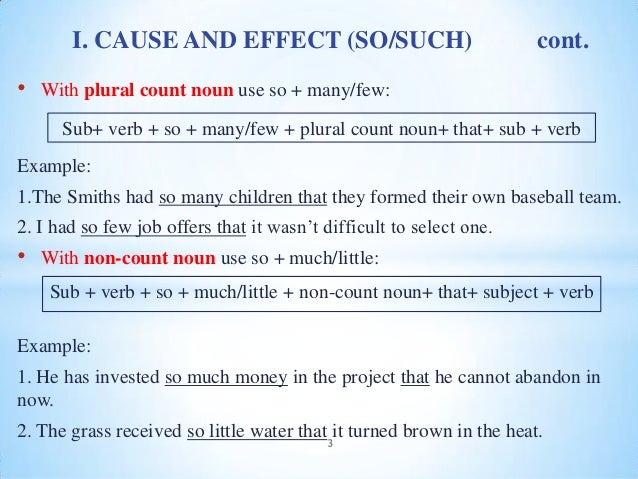
SO/SUCH

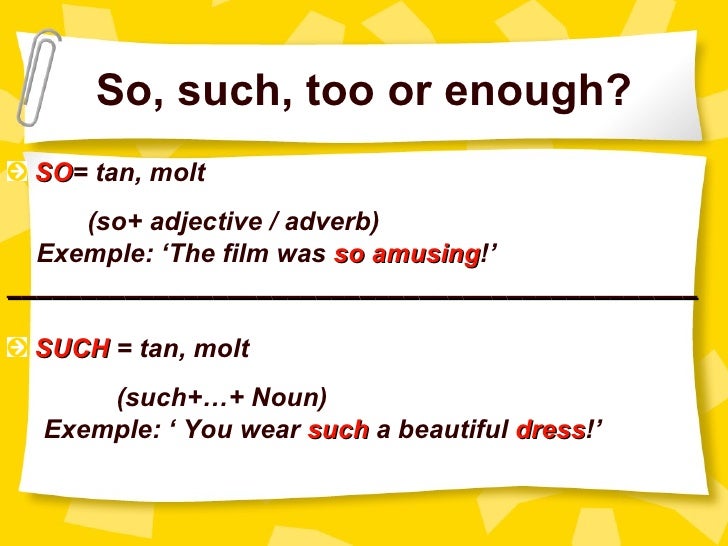
SO / SUCH


PRESENT PERFECT

PRESENT PERFECT


THE PRESENT PERFECT IS FORMED BY COMBINING THE AUXILIARY VERB "HAS" OR "HAVE" WITH THE PAST PARTICIPLE.

THE PRESENT PERFECT IS A COMPOUND TENSE, TWO VERBS ARE REQUIRED: THE MAIN VERB AND THE AUXILIARY VERB.

  • I have studied (main verb: studied; auxiliary verb: have)
  • He has written a letler to María (main verb: written; auxiliary verb: has)
  • We have been stranded for six days (main verb: been; auxiliary verb: have)


SUPERSTITIONS OF GERMANY

SUPERSTITIONS

The 42 % of the Germans keep on believing in the trefoil of four leaf clover, 36 % would like finding occasionally a chimney brush and 40 % believes in the luck associated with a shooting star. And the fact is that these tendencies have its logic. To find a trefoil of four leaf clover is not an easy task and the one that finds it: what luck! It has found one in millions. Other of the icons of the luck in Germany. Other of the icons of the luck in Germany. Also logic is the belief in the luck that brings the chimney brush. In the antiquity it might be compared with the fortune that rings at the doorbell in one winter day. Someone had to set to work the chimney. How not to believe this way in the force that was bringing the chimney brush in the icy days of the German winter? The bad auguries as the associates to the number thirteen are much more awesome. More of the fourth part of the population does not discard the sense of the magic of the numbers. It is not a prank with so many coincidences on this number. According to some, in the Last Dinner there were 13 messmates, the cabbala was accounting for 13 spirits of the evil, the arrival of the Antichrist and the Beast they are gathered in the chapter XIII of the Apocalypse, and in the tarot this digit refers to the death. On the other hand, 25 % of the Germans would avoid if it was possible that a black cat was crossing him for the street. The cat was already considered to be in Egypt a power animal. Also, in the dark middle age, one was associating the black cat with the witches, what of course gave birth to the current superstition.

jueves, 4 de diciembre de 2014


TRANSPORT


     CAR                     BUS              TAXI


 TRAIN                        BIKE                 VAN


 TRAM                   UNDERGROUND              PLANE


HELICOPTER


WHAT I WAS LOS CABOS LIKE 200 YEARS AGO.

200 YEARS AGO LOS CABOS WAS INHABITAD BY NATIVES, CALLED PERICUES, IN THOSE TIME ARRIVED THE PRIESTS SPAINS LOS CABOS,TRYED  INCULCATE THE RELIGION AND MODALS. THE PERICUES WAS VERY AGRESSIVE WITH THE PRIESTS AND LITTLE SURVIVED, BECAUSE THE NATIVES KILLED.

miércoles, 3 de diciembre de 2014


SENTENCES

1.- A: Did you buy that new fridge?
B: No, it was too big to fit in my kitchen.

2.- A: Did you cook dinner?
B: No, there was enough food from last night.

3.- A: What's wrong?
B: This microwave is too complicated I can't use it.

4.- A: I can't lift this armchair. It's too heavy.
B: Let me help you

5.- A: I don't have enough time to help you clean the fridge.
B: That's OK. I'll do it.

martes, 2 de diciembre de 2014


REGULAR VERB

1.- Drake accepted his graduate diploma.
Do drake accept your graduate diploma?
Drake does not accept your graduate diploma.

2.- Monica annoys his sisters.
does monica hurt his sisters?
Monica doesn't bother her sisters.

3.- Nancy asked the task of yesterday.
Nancy question the task yesterday?
Nancy don't ask the task of yesterday.

4.- Pamela and Ernesto discussed by anything.
Do Pamela and Ernesto discussed by anything?
Pamela and Ernesto not discussed by any thing.

5.- Michelle attended all his classes.
Does Michelle attends all their classes?
Michelle doesn't attend all their classes.

IRREGULAR VERB

1.- She begins her day at 7 o'clock.
Does she begins her day at 7 o'clock?
She doesn't begin their day at 7 o'clock.

2.- He is biting an apple.
Does this biting an apple?
He isn't biting an apple.

3.- They are buying clothes at the mall.
Are they buying clothes in the mall?
They aren't buying clothes in the shopping center

4.- Dayna broke with her boyfriend yesterday.
 Does Dayna broke with her boyfriend yesterday?
Dayna didn't break off with her boyfriend yesterday.

5.- Chris drawing his family in the school.
Did chris draw its family in the school?
chris didn't  draw its family in the school


viernes, 3 de octubre de 2014

PLANETS OF THE SOLAR SYSTEM

Mercury

Mercury (0.4 AU from the Sun) is the closest planet to the Sun and the smallest planet in the Solar System (0.055 Earth masses). Mercury has no natural satellites; besides impact craters, its only known geological features are lobed ridges orrupes, probably produced by a period of contraction early in its history. Mercury's almost negligible atmosphere consists of atoms blasted off its surface by the solar wind. Its relatively large iron core and thin mantle have not yet been adequately explained. Hypotheses include that its outer layers were stripped off by a giant impact; or, that it was prevented from fully accreting by the young Sun's energy.

Venus

Venus (0.7 AU from the Sun) is close in size to Earth (0.815 Earth masses) and, like Earth, has a thick silicate mantle around an iron core, a substantial atmosphere, and evidence of internal geological activity. It is much drier than Earth, and its atmosphere is ninety times as dense. Venus has no natural satellites. It is the hottest planet, with surface temperatures over 400 °C (752°F), most likely due to the amount of greenhouse gases in the atmosphere. No definitive evidence o.f current geological activity has been detected on Venus, but it has no magnetic field that would prevent depletion of its substantial atmosphere, which suggests that its atmosphere is frequently replenished by volcanic eruptions.

Earth

Earth (1 AU from the Sun) is the largest and densest of the inner planets, the only one known to have current geological activity, and the only place where life is known to exist. Its liquid hydrosphere is unique among the terrestrial planets, and it is the only planet where plate tectonics has been observed. Earth's atmosphere is radically different from those of the other planets, having been altered by the presence of life to contain 21% free oxygen. It has one natural satellite, the Moon, the only large satellite of a terrestrial planet in the Solar System.

Mars

Mars (1.5 AU from the Sun) is smaller than Earth and Venus (0.107 Earth masses). It possesses an atmosphere of mostly carbon dioxide with a surface pressure of 6.1 millibars (roughly 0.6% of that of Earth). Its surface, peppered with vast volcanoes, such as Olympus Mons, and rift valleys, such as Valles Marineris, shows geological activity that may have persisted until as recently as 2 million years ago. Its red colour comes from iron oxide (rust) in its soil.[77] Mars has two tiny natural satellites (Deimos and Phobos) thought to be captured asteroids.

Jupiter

Jupiter (5.2 AU), at 318 Earth masses, is 2.5 times the mass of all the other planets put together. It is composed largely of hydrogen andhelium. Jupiter's strong internal heat creates semi-permanent features in its atmosphere, such as cloud bands and the Great Red Spot.
Jupiter has 67 known satellites. The four largest, Ganymede, Callisto, Io, and Europa, show similarities to the terrestrial planets, such as volcanism and internal heating. Ganymede, the largest satellite in the Solar System, is larger than Mercury.

Saturn

Saturn (9.5 AU), distinguished by its extensive ring system, has several similarities to Jupiter, such as its atmospheric composition and magnetosphere. Although Saturn has 60% of Jupiter's volume, it is less than a third as massive, at 95 Earth masses, making it the least dense planet in the Solar System. The rings of Saturn are made up of small ice and rock particles.
Saturn has 62 confirmed satellites; two of which, Titan and Enceladus, show signs of geological activity, though they are largely made of ice. Titan, the second-largest moon in the Solar System, is larger than Mercury and the only satellite in the Solar System with a substantial atmosphere.

Uranus

Uranus (19.2 AU), at 14 Earth masses, is the lightest of the outer planets. Uniquely among the planets, it orbits the Sun on its side; its axial tilt is over ninety degrees to theecliptic. It has a much colder core than the other gas giants and radiates very little heat into space.
Uranus has 27 known satellites, the largest ones being Titania, Oberon, Umbriel, Ariel, and Miranda.

Neptune

Neptune (30 AU), though slightly smaller than Uranus, is more massive (equivalent to 17 Earths) and therefore more dense. It radiates more internal heat, but not as much as Jupiter or Saturn.
Neptune has 14 known satellites. The largest, Triton, is geologically active, with geysers of liquid nitrogen. Triton is the only large satellite with a retrograde orbit. Neptune is accompanied in its orbit by several minor planets, termed Neptune trojans, that are in 1:1 resonance with it.

THE SOLAR SYSTEM 

The Solar System comprises the Sun and the objects that orbit it, whether they orbit it directly or by orbiting other objects that orbit it directly. Of those objects that orbit the Sun directly, the largest eight are the planets that form theplanetary system around it, while the remainder are significantly smaller objects, such as dwarf planets and small Solar System bodies (SSSBs) such as comets and asteroids.
The Solar System formed 4.6 billion years ago from the gravitational collapse of a giant molecular cloud. The vast majority of the system's mass is in the Sun, with most of the remaining mass contained in Jupiter. The four smaller inner planets, Mercury, Venus, Earth and Mars, also called the terrestrial planets, are primarily composed of rock and metal. The four outer planets, called the gas giants, are substantially more massive than the terrestrials. The two largest, Jupiter and Saturn, are composed mainly of hydrogen and helium; the two outermost planets, Uranus andNeptune, are composed largely of substances with relatively high melting points (compared with hydrogen and helium), called ices, such as water, ammonia and methane, and are often referred to separately as "ice giants". All planets have almost circular orbits that lie within a nearly flat disc called the ecliptic plane.
The Solar System also contains regions populated by smaller objects. The asteroid belt, which lies between Mars and Jupiter, mostly contains objects composed, like the terrestrial planets, of rock and metal. Beyond Neptune's orbit lie theKuiper belt and scattered disc, linked populations of trans-Neptunian objects composed mostly of ices. Within these populations are several dozen to more than ten thousand objects that may be large enough to have been rounded by their own gravity. Such objects are referred to as dwarf planets. Identified dwarf planets include the asteroid Ceresand the trans-Neptunian objects Pluto and Eris. In addition to these two regions, various other small-body populations, including comets, centaurs and interplanetary dust, freely travel between regions. Six of the planets, at least three of the dwarf planets, and many of the smaller bodies are orbited by natural satellites, usually termed "moons" after Earth's Moon. Each of the outer planets is encircled by planetary rings of dust and other small objects.
The solar wind, a flow of plasma from the Sun, creates a bubble in the interstellar medium known as the heliosphere, which extends out to the edge of the scattered disc. The Oort cloud, which is believed to be the source for long-period comets, may also exist at a distance roughly a thousand times further than the heliosphere. The heliopause is the point at which pressure from the solar wind is equal to the opposing pressure of interstellar wind. The Solar System is located in the Orion Arm, 26,000 light years from the center of the Milky Way.
SENTENCES OF THE WATER CYCLE.

1.- If water is heated to 100° C, it bolils.
2.- If you freeze water, then you get ice.
3.- If the water is too hot it evaporated.
4.- If the vapor condenses into clouds, then rain.
5.- If rain water falls to the ground, it can absorb it.


THE WATER CYCLE.

Water exists on Earth in three States: liquid, solid (ice, snow) and gas (water vapour). Oceans, rivers, clouds and rain are in constant change: the surface water evaporates, the water of the clouds precipitates, rain seeps from the Earth, etc. However, the total amount of water on the planet does not change. Circulation and conservation of water on Earth is called hydrological cycle, or the water cycle. When it was formed, approximately four thousand five hundred million years ago, Earth had water vapor inside.
In the beginning, was a huge ball in constant merger with hundreds of active volcanoes on its surface. Magma, gases with water vapor-Laden, emerged to the surface thanks to the constant eruptions. Then the Earth cooled, the water vapour is condensed and again fell to the ground as rain.

El Ciclo del Agua

jueves, 12 de junio de 2014

3.9 write a short leaflet about how to ride your bike safely.

to ride a bike safely you must: 
1 -. Wear helmets 
. 2 - do not get between the cars 
3 -. Did not bring my headphones and listening to music 
. 4 - pay attention to the road 
5 -. Observe traffic signals

3.8 SPEAKING 

Ask and answer the questions.

what does this sign mean?
1 means you can not smoke in the place where the sign is located. 2 you should not feed the animals. 3 silent, ie, they can not speak out loud. 4 that can not be nailed to the pool hechar. and 5 who can not walk on the grass.